Must-play songs
The tracks you would genuinely notice were missing from the night.
Send the choices that define your party, not a minute-by-minute running order. A clear brief gives the DJ direction while leaving room to respond to your guests.
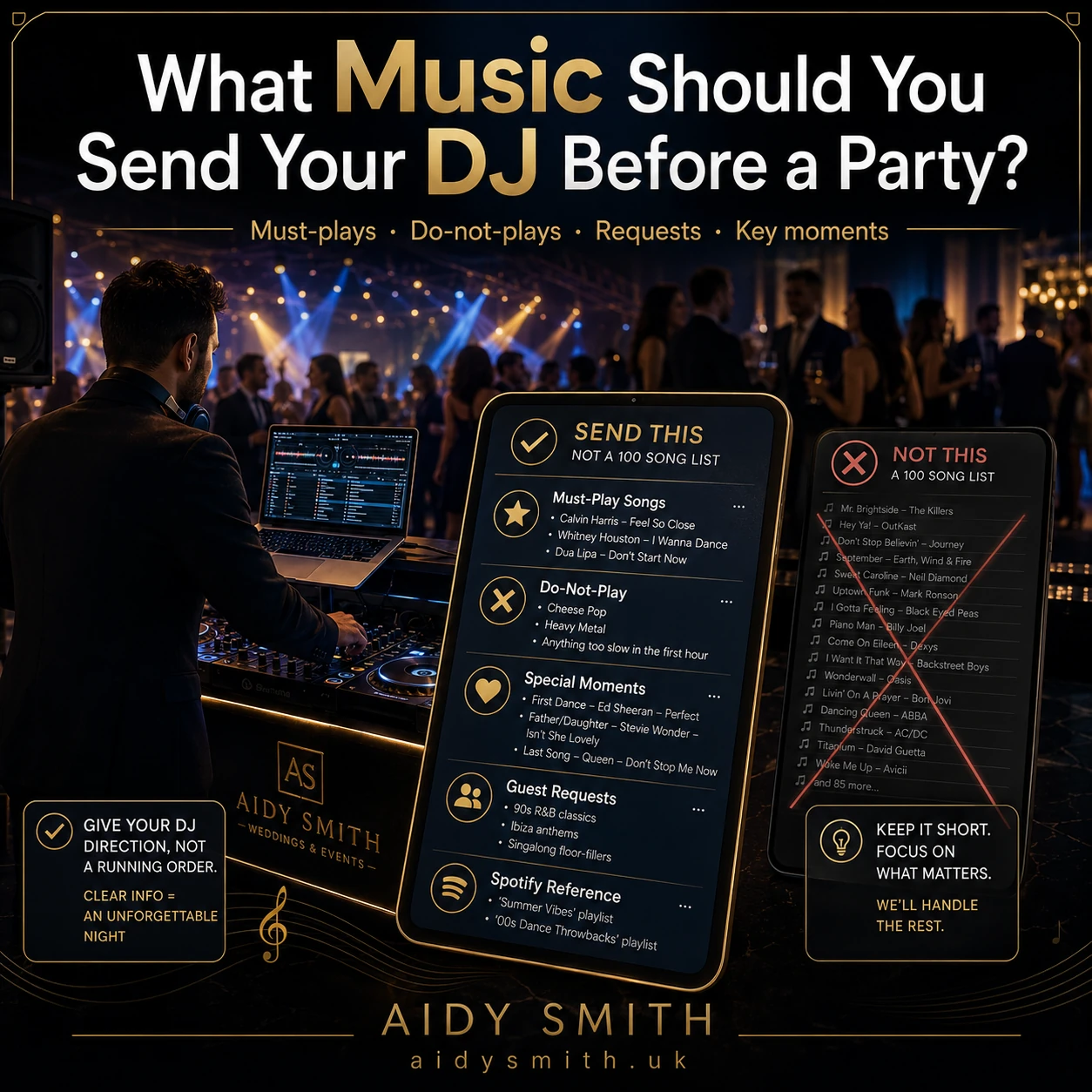
Before a party, your DJ needs to understand what matters to you. That normally means the songs that must happen, the music that best represents your taste, anything that should be avoided, and any tracks connected to a specific moment.
The useful brief is not necessarily the longest one. A list of hundreds of unlabelled songs can hide the choices that really matter. A shorter, organised brief makes it clear what is essential and where the DJ can adapt around the guests in the room.
The tracks you would genuinely notice were missing from the night.
Examples that show the sound of your party without fixing every transition.
Clear limits that protect the host’s preferences when guests start asking.
A must-play is not simply a song you like. It is a track connected to the person, the occasion or a memory that makes it part of the event. These are the choices the DJ should be able to identify immediately.
“A bit of everything” sounds flexible, but it tells a DJ very little. Two people can use that phrase while imagining completely different nights. One may mean 1980s pop, Motown and current chart music; another may mean house, garage and drum and bass. Seasonal events need a little more structure; the Christmas party music guide explains how to balance festive tracks with the wider playlist.
Give a few artists, songs, decades or styles that represent what you actually enjoy. It is also useful to say which part of that music matters most: familiar singalongs, heavier club tracks, nostalgic favourites or a relaxed start that builds later.
For example: “We like 1990s and 2000s dance music, current pop and a few indie singalongs. Please keep novelty party songs to a minimum.” That brief is far more useful than an enormous playlist with no explanation.
There may be a song that carries the wrong memory, an artist the guest of honour dislikes, or a style that simply does not belong at your event. Tell the DJ before the party rather than hoping it never appears in a request.
List the exact song, artist or clearly defined style. You do not need to justify a personal choice, but a short explanation can help when the restriction is broader.
“No song X because it is linked to a previous relationship” is clear. “No old music” is harder to interpret when different guests define old music differently.
At birthdays, anniversaries and private parties, guests may confidently request music the host has already ruled out.
A clear do-not-play list allows the DJ to handle that moment without making the organiser explain the decision during the event.
Some music is not part of the general set. It has a job to do at a particular point in the event. These choices need more detail than an ordinary request because the wrong version or an unclear cue can spoil the moment.
Confirm who is entering, the track, the version and who will give the DJ the signal.
Say whether the song should begin before the announcement, underneath it or immediately afterwards.
Choose whether it is a fixed track or a preferred option that can change if the room is moving in a different direction.
Requests are easier to manage when the organiser’s preference is known in advance. You may want guests to feel involved, but that does not mean every request should interrupt the direction of the night.
A request can be considered against the must-plays, do-not-plays, age range, occasion and what is already working. The useful decision is not simply “requests allowed: yes or no.” It is how much influence guests should have over the host’s party.
Guests can suggest music, with the DJ deciding when and whether each choice fits.
Suggestions are welcome when they match the agreed styles and avoid excluded music.
The DJ follows the organiser’s plan without taking general requests from guests.
A Spotify playlist is useful because it shows real examples. The problem begins when one list is expected to mean several different things at once. The DJ cannot tell whether every track is compulsory, whether the order matters or whether the list is simply a collection of ideas unless you say so.
A clearly labelled short list of the songs that need to be included.
A wider reference playlist showing artists, decades and styles that suit you.
A written list is usually clearest here, especially when the exclusions are specific.
The order of a reference playlist does not need to become the order of the party. A song that looks right on paper may work better earlier, later or not at all depending on the room.
Read: DJ or Spotify Playlist?The DJ cannot see which ten tracks matter most if every choice appears equal.
Party timings move, guests arrive late and the dancefloor may respond differently from expected.
Agree one organiser or final decision-maker before different guests send competing instructions.
Say whether a new song replaces an earlier choice or is simply another possible option.
For an Aidy Smith party booking, we can agree the must-plays, music direction, do-not-plays, key timings and approach to guest requests before the event. Those decisions form the brief for the night.
I then use that brief while watching how the guests respond. Your priorities stay at the centre, but the wider set can move between ages, styles and energy levels rather than following a list that was fixed before anybody entered the room.
That balance is the aim: the party should sound like yours without making you manage every song yourself.
Keep the list short enough for every track to remain genuinely essential. Put the wider selection of music you like in a separate reference playlist.
Yes. Label which songs are must-plays and which simply demonstrate your taste. The playlist does not need to become a fixed running order.
Include a focused do-not-play list when particular songs, artists or styles would be wrong for the host or occasion.
Yes, if that is the approach you want. Requests can be considered within the agreed brief rather than automatically overriding it.