What Makes a Good Drum and Bass DJ Set?
A strong drum and bass set is not just about playing the biggest tunes. For me, it comes from years of listening, practising, building a style of your own and knowing how to move a set forward without killing its progression.
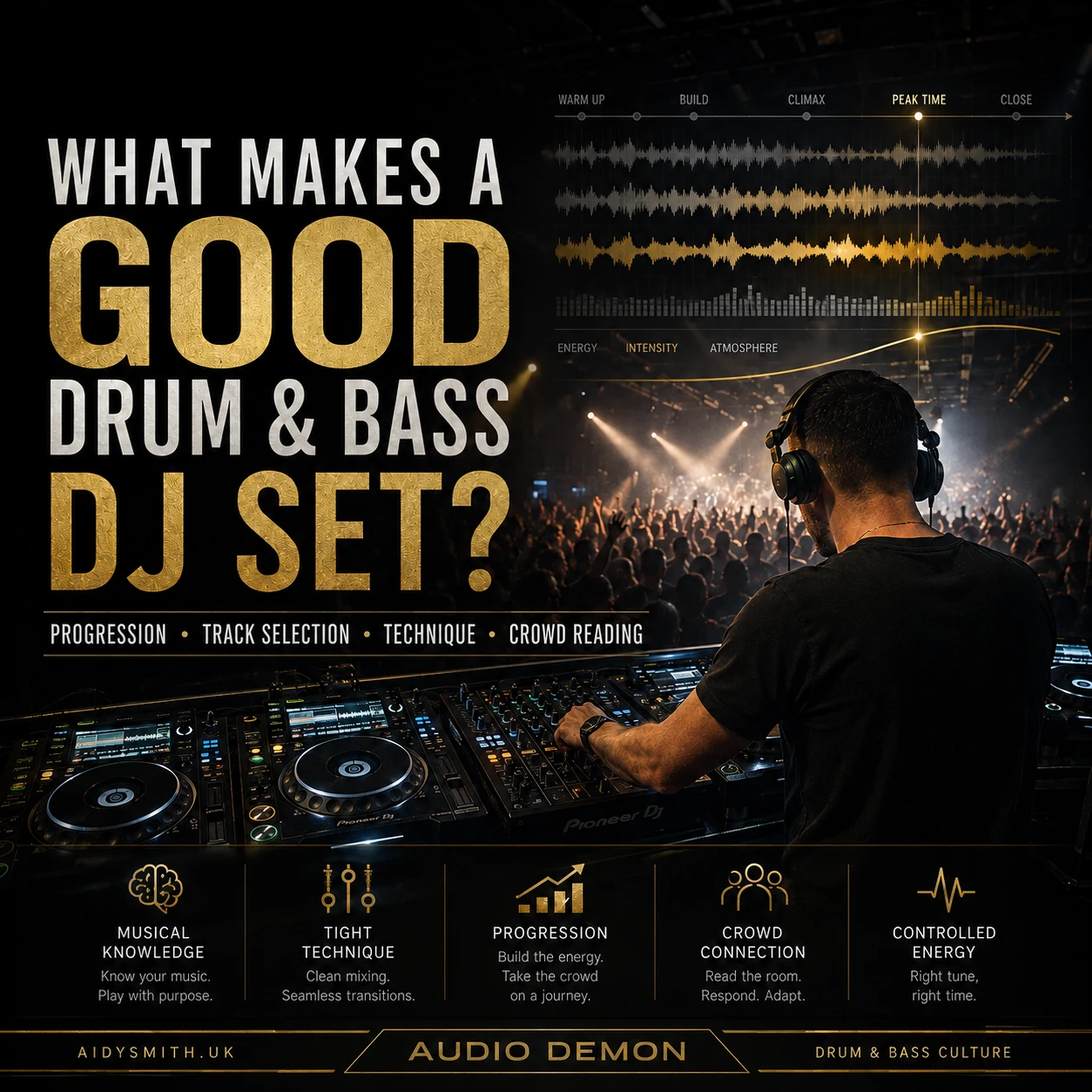
A Good D&B Set Has Knowledge, Technique and Progression
For me, a good drum and bass DJ is somebody with a broad knowledge of the scene who has spent years mixing, listening and practising their technique. Tight mixes matter, but they are only one part of it. The DJ also needs to understand how to build a set so it feels like it is going somewhere.
The biggest mistake is thinking a good set means playing the biggest tracks immediately. If you go straight to the bangers, you can kill the progression. I would rather let the set build in stages so there is still somewhere to take the room later.
Do Not Go Straight to the Biggest Tracks
A drum and bass set works best when it has progression. That does not mean every set has to start soft, but the energy should have somewhere to go. If every tune is treated like the final track of the night, the set can peak too early and then struggle to build anything after it.
I prefer to move through the set progressively, increasing the energy when the room is ready for it. That creates contrast between different sections of the mix and makes the stronger moments feel bigger when they arrive.
There can always be exceptions. The set time, the DJ before you and the type of night all affect where you should begin. The important thing is understanding the point in the night you are taking over rather than treating every booking like a blank slate.
A Drum and Bass DJ Is Usually Booked for a Particular Sound
Reading the dancefloor still matters, but drum and bass is slightly different from a general party booking. A D&B DJ is normally booked because their own style fits the subgenre and the type of night the promoter is running.
That means I would not completely abandon my own flavour just because one tune gets a different reaction. I can change direction if I want to and it often helps, but the starting point is still the sound I was booked to play.
If a night is built around liquid, jump-up, deeper material or another side of D&B, that gives the DJ a framework. Inside that framework there is still plenty of room to react to the energy in front of you.
Watch the DJs Before You and Watch the Crowd
One of the best ways to judge where to take a set is to watch what is happening before you play. I pay attention to the DJs before me and how the crowd responds to them. That gives me a much better idea of the energy already in the room than looking at a planned playlist in isolation.
If the room feels like it wants more energy, I may take the set deeper and push it further. If people are reacting strongly to classics, I can move more in that direction. The point is not to copy the previous DJ; it is to understand where the room is before you take control of it.
Not Every Good DJ Mixes in the Same Way
Drum and bass gives DJs a lot of room to develop their own mixing style. Some DJs are known for double drops, long blends and very active mixing. Others let more of each tune play before bringing in the next track.
For me, both approaches can work when they suit the DJ and the moment. Mampi Swift is an example I associate with double dropping and blending tracks together, while Grooverider is a DJ I associate more with letting tracks run further, often allowing the tune to breathe before moving into the next one.
That is why I do not think there is one correct number of mixes per hour. A DJ can over-mix if every tune is cut short just to prove something technically, but equally a fast, layered style can sound brilliant when somebody has the experience and control to make it work.
Knowing When to Mix the Next Track Is Essential
Technical mixing is very important in drum and bass. Tight beatmatching and clean transitions matter, but timing is just as important. Knowing when to bring the next tune in is part of keeping the set moving.
A technically perfect transition can still feel wrong if it happens at the wrong point in the track. Equally, leaving a tune running for longer can be exactly what the room needs if the track is working. Good technique is not just about what the DJ can do; it is about choosing when to do it.
Prepare Beforehand, Then Leave Room to React
I normally plan parts of a set before the night. I will also check the latest drum and bass releases online so I know what is new and what I may want to bring into the mix.
That preparation does not mean locking the whole set into one fixed running order. Once I am in the room, I can change things depending on what is happening. If the crowd is clearly enjoying classic tracks, for example, I can move further into that style instead of insisting on the exact sequence I had in mind beforehand.
For me, that balance works best: know your music, prepare properly, then have enough knowledge of your collection to change direction without losing the flow of the set.
A Good D&B Set Should Feel Like a Journey
The best drum and bass sets are not just collections of strong tracks. They have knowledge behind them, tight technique, their own musical identity and a sense of progression from one section to the next.
For me, the DJ should know the scene, understand the records, watch what is happening in the room and have enough experience to decide when to build, when to change direction and when to let a tune breathe. The goal is to keep the mix moving while still making the whole set feel connected.