How close can I unload?
A nearby loading point saves repeated long carries with the booth, speakers, stands, lighting and cases.
For my full party setup, I normally want around two hours before guests are due to arrive. That time covers much more than putting a booth and two speakers in the room.
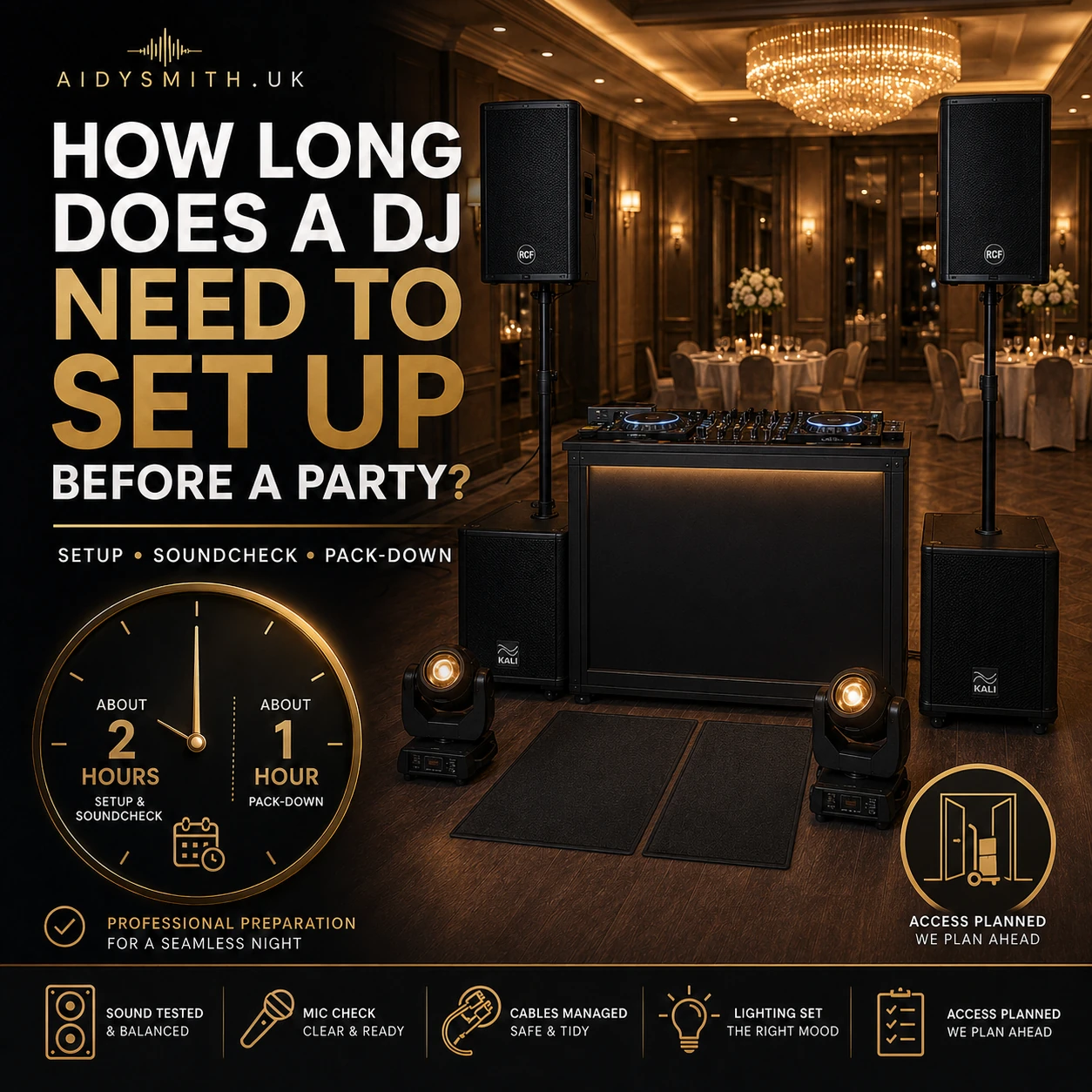
If guests are due to arrive at 7pm, I normally want venue access from around 5pm for a full Aidy Smith setup. That gives me time to get the equipment from the vehicle into the room, assemble everything properly, wire it, tidy the cabling and test the complete system before the party starts.
Two hours is an allowance rather than a promise that every setup takes exactly 120 minutes. A straightforward ground-floor room with close parking may move quickly. Stairs, a long carry from the vehicle, restricted access or a booking that needs additional equipment can push the other way.
Venue access has a direct effect on how long I need. Parking beside a function-room entrance is very different from unloading at one side of a building and moving the equipment through corridors, lifts or flights of stairs before I even reach the space where I am playing.
A nearby loading point saves repeated long carries with the booth, speakers, stands, lighting and cases.
Large venues can involve several trips through long corridors before any equipment reaches its final position.
Stairs slow down safe movement of larger equipment, particularly when there is no suitable lift.
The DJ cannot start a two-hour setup if another event, room turnaround or venue restriction prevents access.
This is why “the DJ needs two hours” is really a venue-access requirement. The clock starts when I can begin moving equipment into the room, not when I arrive in the car park.
Read: What a DJ Needs From Your VenueThe exact order can move around the room and the booking, but a full setup involves several separate jobs. It is not a case of unfolding a table, connecting a laptop and pressing play.
I assemble the DJ booth in the agreed performance area first. That gives the rest of the setup a clear centre point and lets me judge where speakers, lighting and cabling need to go.
The booth is not simply decorative. Its position affects the usable working space behind it, the cable routes and how neatly the complete setup sits in the room.
The speakers and their stands need to be assembled and positioned around the room. I still leave room to adjust them once the system is live and I can hear how the space responds.
Speaker placement matters. A visually tidy position is not automatically the position that gives the best coverage or balance.
Subwoofers are not automatically part of every booking. When they are required, there is more equipment to bring in, position, connect and balance with the main speakers.
Their placement is part of the sound-system decision rather than something I want to squeeze into whatever floor space happens to be left.
The DJ equipment depends on the booking. That may be the laptop-based setup or CDJs, with the relevant mixer and audio connections prepared at the booth.
This stage connects the performance equipment to the sound system, but the system still has not been properly tested in the room.
Once the main equipment is taking shape, I can position the lighting so it complements the booth and sound system without creating awkward obstructions around the working area.
The lighting then needs its own power and control connections, adding another set of cables that need to be routed cleanly.
Power and audio cables build up quickly once the booth, speakers, subwoofers and lighting are connected. Getting a signal is only part of the job.
I also want the cabling organised and the setup looking finished before guests enter the room, rather than leaving loose runs around the performance area.
Once the booth is assembled, the speakers are up and the lights are in position, the room can already look ready for a party. That is not where I want the setup process to end.
The complete audio chain still needs testing. I check that the playback equipment, mixer, speakers and any subwoofers are working together correctly, listen to the balance in the room and make changes to speaker placement or levels where needed.
If a microphone is being supplied, I check that too. It is much better to find a loose connection, unexpected level difference or awkward speaker position while the room is empty than when somebody is about to make an announcement.
It is easy to look at a small function room and assume setup should be quicker. If the equipment has to travel through a difficult building to reach it, the opposite can be true.
Parking close to a ground-floor function room makes repeated equipment trips much more straightforward and protects the time available for setup and testing.
The same equipment takes longer when every case, stand and speaker has to travel further, use stairs or wait for a lift. In that situation I may need earlier access rather than rushing the final soundcheck.
For setup planning, the useful details are practical: where I can unload, whether there are stairs, whether a lift is suitable, how far the equipment needs to travel inside the venue and what time the function room becomes available.
Those details let me arrive with a realistic plan rather than discovering a 15-minute equipment route after the setup window has already started.
For a full setup, I normally allow around one hour after the party to pack everything away. The system has to be powered down, cables disconnected and coiled, the lighting and speaker system dismantled, the booth packed and all the equipment moved safely back to the vehicle.
The same access issues apply in reverse. A long route, stairs or a distant vehicle can extend the load-out just as they can extend setup.
Take a party running from 7pm until midnight. With roughly two hours allowed for the full setup and around one hour to pack away, the on-site window can run from about 5pm until 1am.
That does not include travelling to the venue or travelling home afterwards. It is one reason the performance time alone does not describe the complete work involved in supplying a full mobile DJ setup.
For my full party setup, I normally allow around two hours before guests are due to arrive. A simpler setup may need less, while difficult access can mean arranging more time.
Yes. For the full setup, the allowance includes getting the equipment into position, wiring it, tidying the cabling, testing the sound system, checking speaker placement and testing the microphone when one is supplied.
The most useful details are the unloading point, distance to the function room, stairs or lift access, room availability time and any restrictions that affect setup or pack down.
I normally allow around an hour for a full pack down and load out, although stairs and a long carrying distance back to the vehicle can extend that.